Defang plans are now based on the number of cloud accounts you deploy into, not the number of people using Defang. Here's why account-based pricing better reflects how teams—and AI agents—build today.
When we first introduced Defang, charging per user made sense. Most applications were deployed by individual developers or small teams, and the people using Defang were the same people writing the code.
That world is changing.
Today, a single cloud account might be used by a team of engineers, CI/CD pipelines, autonomous coding agents, or all three. Defang isn't just helping people deploy applications anymore—it's helping software deploy software.
As we've watched customers adopt these new workflows, it's become clear that charging per user no longer reflects how Defang creates value.
So we're changing our pricing.
From users to cloud accounts
Starting today, Defang plans are based on the number of cloud accounts you deploy into, rather than the number of people using Defang.
Why?
Because the cloud account is the resource that Defang manages.
Whether one developer deploys into an AWS account, or an entire engineering organization does, or a fleet of AI agents continuously ships changes there, Defang is managing the same deployment environment.
The cloud account has become the natural unit for pricing.
Better for teams—and for agents
This change has another important benefit: it removes friction around collaboration.
You shouldn't have to think twice before inviting another teammate to help debug a deployment, review infrastructure, or ship a feature.
Likewise, as AI agents become an increasingly important part of the software development lifecycle, it doesn't make sense to treat every agent as another "user" that requires its own license.
People, agents, and automation should be able to work together without changing your bill every time you add another participant.
Focusing on your cloud, not ours
As part of this change, we're also retiring the Defang Playground.
When we launched the Playground, it was a great way to help developers get started quickly and experience Defang without needing their own cloud infrastructure.
Over time, however, we've seen the vast majority of production deployments—and increasingly, development workflows as well—move into customers' own cloud accounts. That's where teams collaborate, where AI agents operate, and where applications ultimately run.
Rather than continuing to invest in a hosted Playground environment, we're focusing our efforts on making deployments into your own AWS, Azure, GCP, and other cloud accounts as seamless as possible.
This lets us invest in the workflows our customers use every day, while giving you complete ownership and control of the infrastructure running your applications.
What this means
With account-based pricing:
- Invite as many teammates as you need.
- Use as many AI agents and automation tools as your workflows require.
- Deploy into your own cloud accounts with Defang managing the deployment experience.
- Pay based on the cloud accounts where Defang is managing deployments.
If you deploy into one cloud account, you're paying for one managed environment. If you deploy into multiple AWS, Azure, GCP, or DigitalOcean accounts, your plan scales with the number of environments you're managing—not the number of humans (or agents) involved.
The Defang Playground will be retired on July 2nd, 2026. If you're currently using the Playground, we'll provide guidance and support to help you migrate your applications into your own cloud account before then. The new Defang Starter Tier allows you to deploy your apps with Defang to your own cloud accounts.
Our philosophy hasn't changed
Our goal has always been to make cloud deployment dramatically simpler.
We believe pricing should reflect the value we provide, and it should encourage collaboration—not discourage it.
As software teams evolve to include both humans and AI agents, we want Defang's pricing model to evolve alongside them.
That same philosophy is why we're focusing Defang on deployments into your own cloud accounts. We believe the future of application deployment is giving developers a simple experience while leaving them in complete control of where their applications run.
Charging by cloud account better reflects how customers use Defang today, and where software development is headed tomorrow.
As always, we'd love to hear your feedback. If you have questions about these changes or how they affect your account, please reach out—we're happy to help.
Related posts
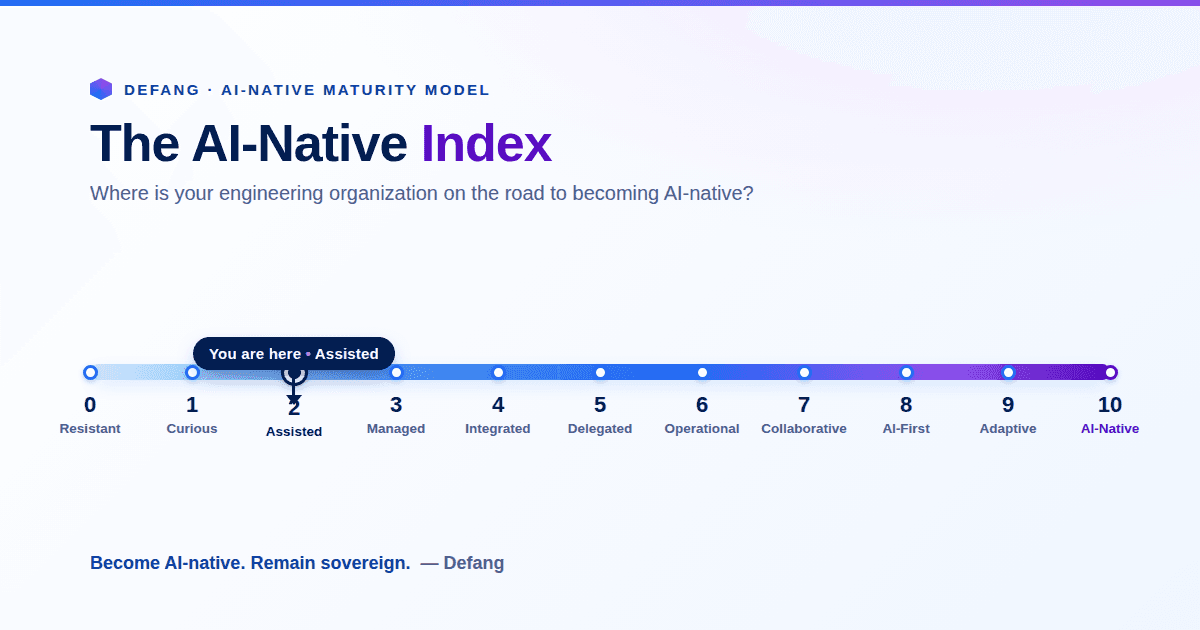
The AI-Native Enterprise: Redesigning Engineering for the AI Era
The next wave of competitive advantage won't come from adopting another AI tool. It will come from redesigning engineering around humans and AI agents working together, while preserving engineering sovereignty.
Introducing Defang Forge: Helping Companies Build for the AI-Native Era
Today, we are excited to introduce Defang Forge, a new engineering practice from Defang that helps organizations design, build, and deploy AI-native software.
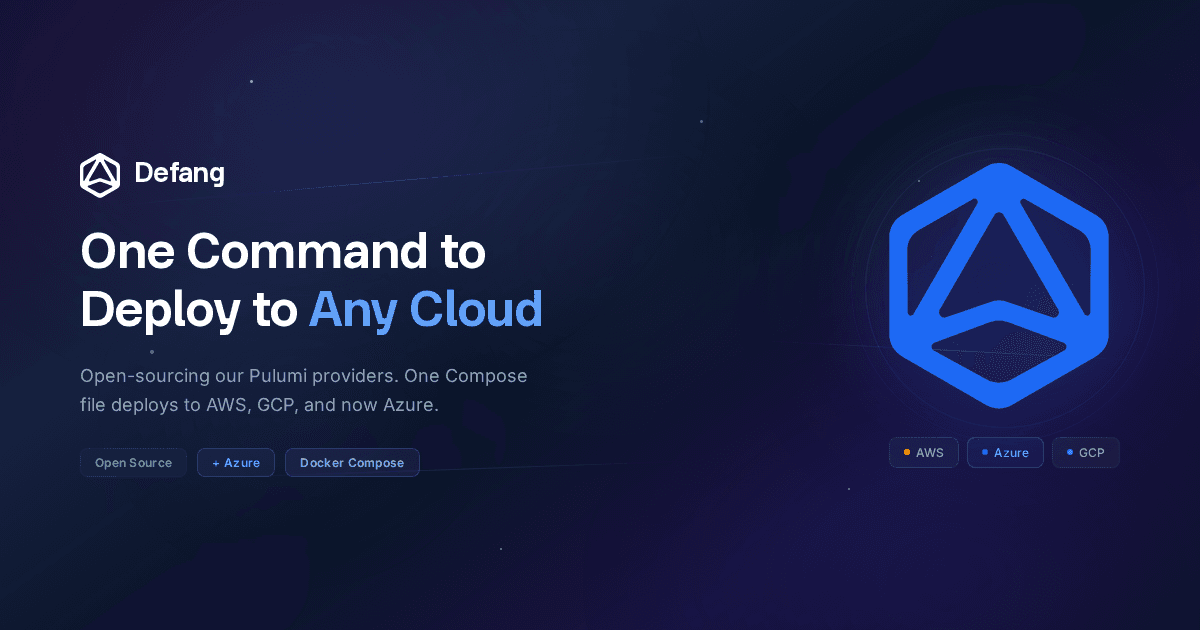
Deploy AI Agents to Any Cloud Account: Open-Sourcing Our Providers and Adding Azure
We're open-sourcing the per-cloud Pulumi providers that power Defang's deployment system and adding Azure to the supported set. One Compose file, one command, any customer's cloud — including managed LLMs, databases, and Redis mapped automatically.